 Peliou

Heavy Duty Ground Protection Mats
1271Peliou Heavy Duty Ground protection MATS are high load-carrying MATS with excellent manufacturing process design and high load-carrying capacity. T...
View detailsSearch the whole station Quick mat Video 产品分类菜单
On a construction site in Hebei, the ground underfoot rarely matches the drawings. A freshly backfilled access road, a muddy pit edge after rain, and the soft soil beneath a crane outrigger each demand something different from a temporary ground mat. Hebei Peliou New Materials Technology Co., Ltd, based in Hengshui, supplies HDPE and UHMWPE ground protection solutions that are best understood not as a single product but as a range of options matched to specific site conditions.
For contractors sourcing from a Hebei manufacturer, the practical question is not simply “which mat is cheapest” but “which thickness and material will survive the loads this site will actually see.” The following breakdown organizes ground mat selection around three common construction conditions, using Hebei Peliou’s published product specifications as a reference point.
Light-Duty Access and Short-Term Walkways
This condition covers municipal repair work, landscaping projects, small equipment access, and pedestrian routes through active sites. The ground may be soft or sensitive—established turf, finished pavement, or compacted gravel—but the loads are modest and the installation is temporary. Here, thinner HDPE mats offer a workable balance of portability and protection.
Hebei Peliou’s standard HDPE ground mats are available in 12.7mm thickness, with common panel sizes including 1220mm × 2440mm, 910mm × 2440mm, and 610mm × 2440mm. At a density of 0.96 g/cm³, these panels are light enough for one or two workers to position without lifting equipment, while the textured surface provides traction over mud, sand, or wet grass. The material remains functional at low temperatures—brittleness is rated below -40°C—which suits the colder months in northern China. For sites where ground protection needs to be laid quickly and recovered just as quickly, this category is the most efficient starting point.
General Earthwork and Medium Equipment Traffic
Most residential and civil construction sites in Hebei fall into this middle tier: excavators, concrete mixers, and delivery trucks moving repeatedly over unpaved haul roads. The ground degrades under repeated wheel passes, and mats must resist creep and displacement while maintaining a continuous running surface.
At this level, thickness becomes the deciding variable. While Hebei Peliou’s cataloged standard products emphasize 12.7mm HDPE panels, the company also supplies UHMWPE sheets and indicates that various thicknesses and sizes can be offered to suit specific needs. UHMWPE offers superior wear resistance and impact strength compared to standard HDPE, making it appropriate for heavily trafficked haul routes where abrasion from tires and tracked equipment would prematurely wear thinner panels. Steel connectors are available to join adjacent mats into a secure roadway, preventing lateral movement under turning vehicles. The key selection principle here is to size for the heaviest vehicle in the rotation, not the average one: a single overloaded concrete truck can deform an undersized panel beyond recovery.
Heavy-Load Soft Ground and Critical Support Points
When the condition involves crane outriggers, piling rigs, or access across genuinely soft ground—silt, peat, or recently disturbed fill—the mat becomes a load-distribution device rather than a simple surface covering. Failure here is not inconvenient; it is a safety and schedule risk.
Hebei Peliou’s product documentation distinguishes UHMWPE as the material suited for oil field and drilling applications, where the requirement is to create a temporary road and prevent heavy equipment from losing traction or sinking into soft ground. For outrigger pads specifically, the company lists heavy-duty ground protection outrigger pads among its offerings, with customization available for size and configuration. In practice, contractors facing this condition should engage the manufacturer directly with the maximum outrigger load and ground bearing capacity, rather than selecting from a stock size list. Thicker UHMWPE sections or reinforced pad assemblies are the appropriate response, and the cost differential is minor compared to the consequences of an outrigger punching through.
A Note on Material Choice
Hebei Peliou operates as a supplier of both HDPE and UHMWPE sheet products, with exports to North America, Europe, Southeast Asia, and other markets. The distinction matters for buyers: HDPE is the economical workhorse for access and light traffic, while UHMWPE justifies its higher cost in abrasive, high-load, or high-cycle applications. The company’s presence on multiple B2B platforms, including SGS-audited supplier profiles, provides a degree of verification for overseas and domestic buyers comparing sources.
For construction projects in Hebei and surrounding regions, working with a local manufacturer shortens the supply chain and allows for more direct technical exchange about ground conditions. The right approach is to classify the site honestly—light access, general earthwork, or heavy soft-ground support—and then specify accordingly. A mat that is too thin for the condition will fail; a mat that is thicker than necessary adds cost and handling effort without benefit. Matching the product to the condition is the whole exercise, and it is one that Hebei Peliou’s range is structured to support.

Peliou Heavy Duty Ground protection MATS are high load-carrying MATS with excellent manufacturing process design and high load-carrying capacity. T...
View details

The Fundamental Difference: Virgin vs. Recycled Material This is the most critical factor, as it dictates the mat's core performance. FeatureHigh-Quality Mats (100% Virgin HDPE)Low-Quali...
View details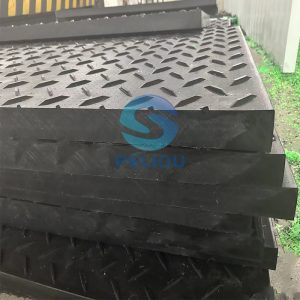
Ultra-high molecular weight polyethylene (UHMWPE) thick road mats are not your typical plastic mats; they are high-performance engineering components designed for extreme conditions. Their uniq...
View details